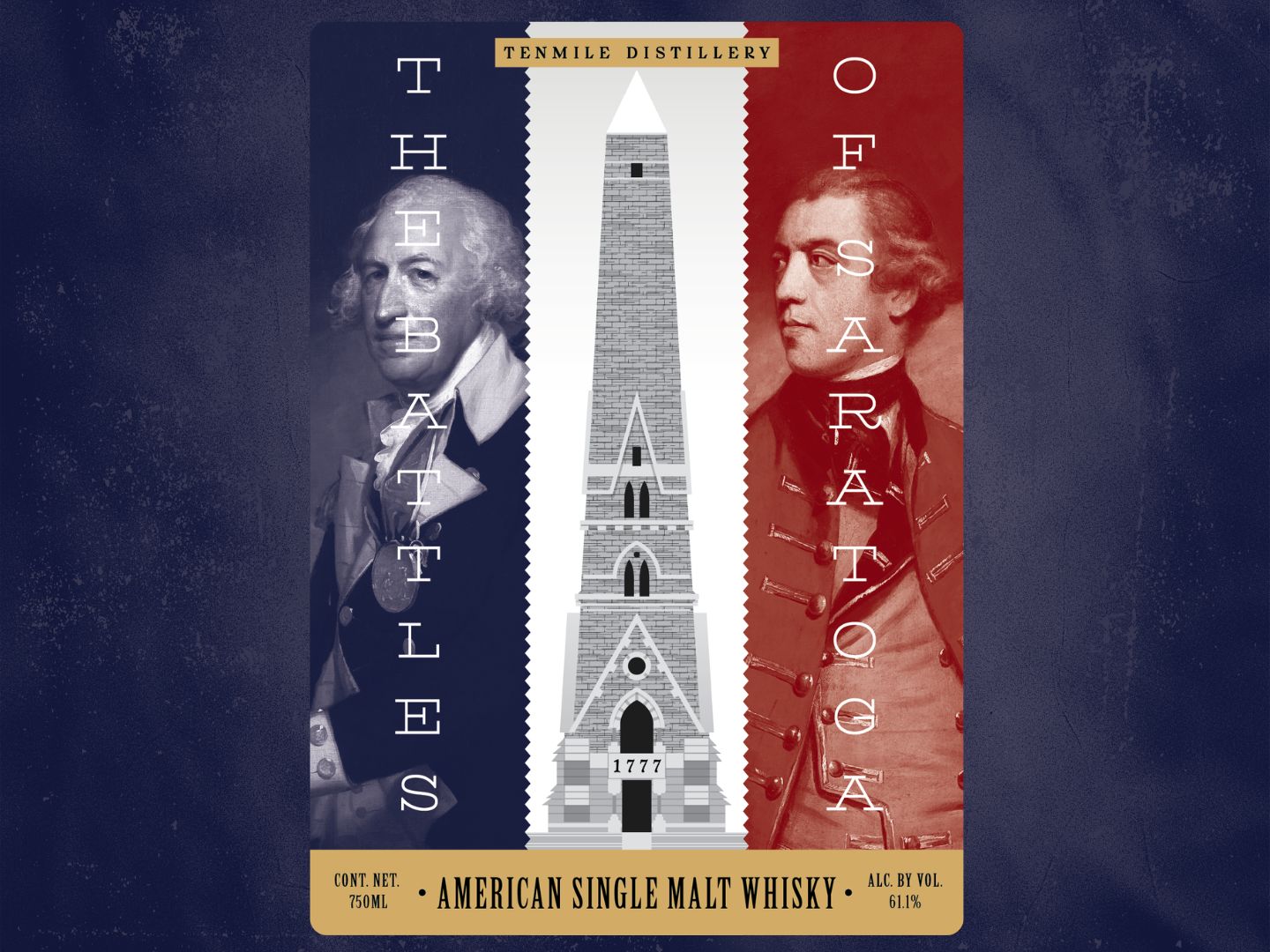
On October 17, 1777, something unprecedented happened in upstate New York: nearly 6,000 British and German professional soldiers laid down their arms and surrendered to an American force of rebels. The Battle of Saratoga wasn’t just a military victory; it was the moment when American independence transformed from a distant dream into a real possibility. It was when a colonial rebellion became a world war.
The British Plan
The British strategy for 1777 seemed brilliant in the planning rooms of London. They would split the colonies by controlling the Hudson River valley, effectively isolating New England from the rest of America. Then they’d crush the rebellion piece by piece.
The plan called for three coordinated forces to converge near Albany. General John Burgoyne would march south from Canada through the Lake Champlain corridor, Lieutenant Colonel Barry St. Leger would advance east along the Mohawk River, and General William Howe would move north from New York City. It was logical but completely dependent on coordination that never materialized.
The fatal flaw? The three commanders received no clear orders to actually coordinate their movements. Howe was supposed to support Burgoyne but decided to pursue his own prize of capturing Philadelphia. This decision would doom Burgoyne’s entire campaign before it truly began.
“Gentleman Johnny”
General John Burgoyne, who was nicknamed “Gentleman Johnny” for his aristocratic flair, began confidently in June 1777, quickly recapturing Fort Ticonderoga. But this early success masked the nightmare ahead. As his 7,000 men pushed south, everything started going wrong.
The Americans, under General Philip Schuyler, implemented a scorched-earth strategy that would make Napoleon’s Russian campaign look like a preview. They destroyed bridges, cut down trees across roads, dammed streams to create flooded areas. Burgoyne’s decision to bring heavy artillery and extensive baggage slowed his movement to barely a mile per day through dense forest.
By August, the situation had deteriorated dramatically. St. Leger’s supporting force was turned back after brutal fighting at Oriskany. A detachment of German troops was crushed at the Battle of Bennington, losing nearly 1,000 men. Burgoyne’s supply lines stretched dangerously thin, yet he pressed on, crossing the Hudson River in mid-September. This was a point of no return that abandoned his supply line back to Canada.
Meanwhile, American forces were growing stronger. Militia from across New England poured in to reinforce the American commander, General Horatio Gates, who established a strong defensive position on Bemis Heights overlooking the Hudson Valley.
Freeman’s Farm
On September 19, Burgoyne advanced toward the American position at Freeman’s Farm. The day-long battle that moved back and forth across a open field. Daniel Morgan’s riflemen picked off British officers with great accuracy, creating chaos in the enemy ranks.
Benedict Arnold, who was still a patriot hero at this point in history, urged action and led reinforcements into the fight. By evening, the British technically held the field but had suffered 600 casualties compared to 300 American losses. More importantly, Burgoyne had failed to break through, and his options were getting slimmer with every passing day.
After the battle, tensions exploded between the cautious Gates and the aggressive Arnold, culminating in Gates relieving Arnold of his command. This was a decision that would backfire spectacularly in the coming battle.
October 7
For three weeks, Burgoyne waited at Freeman’s Farm, hoping for reinforcements from the south that would never arrive. By early October, Gates commanded nearly 11,000 men to Burgoyne’s 6,000. Winter was approaching, supplies were dwindling, and desperation forced Burgoyne’s hand.
On October 7, he led 1,500 men in a reconnaissance in force to probe the American left flank. Gates responded by sending Morgan’s riflemen and Continental regiments to counter the move. The fighting began around 2 p.m. and quickly intensified.
Then came one of the most dramatic moments of the Revolution. Benedict Arnold, officially relieved of command and ordered to stay in camp, couldn’t resist the sound of gunfire. He mounted his horse and galloped toward the battle, taking charge of various units and inspiring the men with his aggressive leadership.
Arnold’s impact was decisive. He led a charge that broke the British center, where German troops under von Breymann were positioned. During this action, Arnold was wounded in the same leg that had been injured at Quebec. Simon Fraser, one of Burgoyne’s best officers, fell fatally wounded to a sharpshooter’s bullet. By the end of the day, the British line had collapsed.
The Surrender
Burgoyne withdrew to Saratoga village, but the Americans chased him and surrounded his battered force. With no escape route, few supplies, and American artillery bombarding his position, the inevitable arrived. On October 17, 1777, Burgoyne surrendered his entire army, including about 5,900 troops, 42 cannons, and 7,000 muskets.
The surrender ceremony was conducted with dignity. When Burgoyne offered his sword to Gates, the American general refused to accept it—a gesture of respect between professional soldiers.
The World Changed
The victory rippled across oceans. In Britain, the news brought shock and disbelief, and many questioned whether the war could be won. In America, confidence surged after months of doubt following defeats around New York and the loss of Philadelphia.
But the most important consequence happened in France. When news of Burgoyne’s surrender reached Paris in December 1777, King Louis XVI’s government made its decision: France would formally recognize American independence and enter the war as America’s ally. Treaties were signed in February 1778, bringing French military and naval power into the conflict.
This French alliance fundamentally transformed the war. A colonial rebellion became an international conflict, with France, Spain, and the Netherlands eventually fighting against Britain. The American Revolution was now a world war.
Without Saratoga, there might be no United States. The French alliance was essential to ultimate American victory, particularly the French fleet that would prove crucial at Yorktown in 1781. The battle showed that American forces could defeat professional European armies through superior leadership and effective tactics, not just luck or British mistakes.
Most importantly, Saratoga came at a critical moment when the revolution might have faltered. It provided the morale boost needed to continue the struggle through four more hard years of fighting.
The road to Yorktown and American independence began at Saratoga. It was truly the turning point of the American Revolution.